Tuesday, October 6, 2015

Diabetes


So, we are studying the endocrine chapter and I had the opportunity to refresh my knowledge about diabetes. I've railed about this for years here, and the typical response is along the lines of, "Yeah, people need to quit stuffing their pie holes". This is more of the same I guess, but I really would like a response about why my outlook is wrong. I think this link is worth taking a look at http://www.diabetes.org/advocacy/news-events/cost-of-diabetes.html

I've made a point before that I think it is ridiculous for men to bitch about paying for contraception in light of how much we spend on diabetes. The link above and this graphic AND my time spent in clinical this past year have further cemented my beliefs. I found another link here that I also think is kind of interesting http://www.theatlantic.com/business/archive/2012/03/the-fiscal-conservatives-case-for-spending-more-money-on-birth-control/254442/

As I have learned from my textbook, 90% of all diabetics in the US are Type II diabetics. In the case of Type I diabetics, who are unable to make insulin, there is really nothing they can do about it. The cells in the pancreas that make insulin are destroyed and they are dependent on insulin for the rest of their life. In the case of Type II diabetics, there is a strong genetic component, however, there is also a lot that an individual can do to either stave off the disease, or stave off complications. In the past year, I have taken care of several patients who, after receiving a diagnosis of diabetes, promptly went on a diet, increased their exercise, and were off of medication within six months. Some other patients, on the other hand, who also seem to hate Obamacare, have gone in precisely the other direction and are on not only medication for diabetes, but are also on medication for cholesterol (note, not because of genetics) and are also on blood pressure medication. All of which are subsidized by private insurance or government funded insurance. In short, I am not only subsidizing their unhealthy lifestyle by paying for their medicine, I am also enabling their behavior because I will be able to prescribe medication for them.

Philosophically, I just cannot see any difference in the position of people who bitch about paying for someone to have risk free sex and my view that paying for diabetes like we do enables a set of behaviors that are equally gluttonous and void of personal responsibility. If conservative men have legitimate reason to complain about paying for a lifestyle they don't approve of regarding contraception, can they really be taken seriously. According to that article, 62.4% of the cost of diabetes is paid for by government insurance. Shouldn't we have the exact same gripe about diabetics? What about smokers?

One of many elephants in the room

So, Kevin McCarthy comes right out and admits the obvious on the Benghazi, namely that the endless regurgitation of the events in Benghazi has one sole purpose, and that is to damage Hillary Clinton in the eyes of those who aren't Republicans.

http://www.foxnews.com/politics/2015/09/30/dems-accuse-gop-leader-mccarthy-admitting-benghazi-panel-is-political/

It's good to know that while Democrats are being instructed not to politicize the shooting in Oregon, we have such upstanding legislators like McCarthy who have the best interests of the nation foremost in his mind. I hope Boehner got a laugh out of watching McCarthy look helpless while Hannity pummeled him.

Monday, October 5, 2015

The Ted Cruz Plan For 2016 Victory

Slow and steady wins the race:

http://thehill.com/homenews/campaign/255791-ted-cruz-sees-slow-and-steady-path-to-2016-victory

More Violence Threatened Today

A posting on social media has threatened more violence at an undisclosed Philadelphia college:

http://www.msn.com/en-us/news/us/fbi-atf-warn-philadelphia-colleges-of-possible-threat/ar-AAf6Zlk?ocid=spartandhp

Sunday, October 4, 2015

The Truth About Gun Violence

Oregon mass shooting is 294th this year, and more data on gun violence


Getty Images
A gun shop in Roseburg, Oregon.


In the aftermath of the shooting at an Oregon community college Thursday that left 10 dead, including the shooter, America once again faces questions over what can be done to address gun violence.
Here are the data, charts and maps seeking to put the issue in perspective.

Mass shootings have become routine in the U.S.

President Obama delivered an emotional statement to the press Thursday lamenting that the U.S. is the only developed country in the world where mass shootings have become commonplace.
There’s data to show that he’s right.
As of Friday, there have been more mass shootings in 2015 than days of the year. That data comes from the Mass Shooting Tracker, which defines a mass shooting as one in which “four or more people are shot in an event, or related series of events, likely without a cooling off period.” It’s been visualized a few different ways from Quartz’s simple bar chart:

Embedded image permalink

To the Washington Post’s calendar tracker, which shows we’ve gone no more than eight days without one of these incidents this year.


Embedded image permalink


Embedded image permalink


Embedded image permalink

Embedded image permalink


The United States has nearly twice as many guns per 100 people as the next closest country.
Embedded image permalink

Somehow this has become routine,” Obama said. “The reporting is routine. My response here at this podium ends up being routine, the conversation in the aftermath of it ... We have become numb to this,” he said.


Gun violence vs. terrorism

In his statement on Thursday, Obama also had a request of the media: “Tally up the number of Americans who’ve been killed through terrorist attacks in the last decade and the number of Americans who’ve been killed by gun violence, and post those side by side on your news reports,” he asked.
Vox did so:

Embedded image permalink


So did The Washington Post:

Embedded image permalink


How politicians are framing the issue

On Friday, Obama said his primary strategy going forward on gun control legislation would be to mount a public campaign. He again called on Americans to change the politics and elect lawmakers who are willing to take steps to curb gun violence.
“You have to make sure that anybody who you are voting for is on the right of this issue,” Obama said.
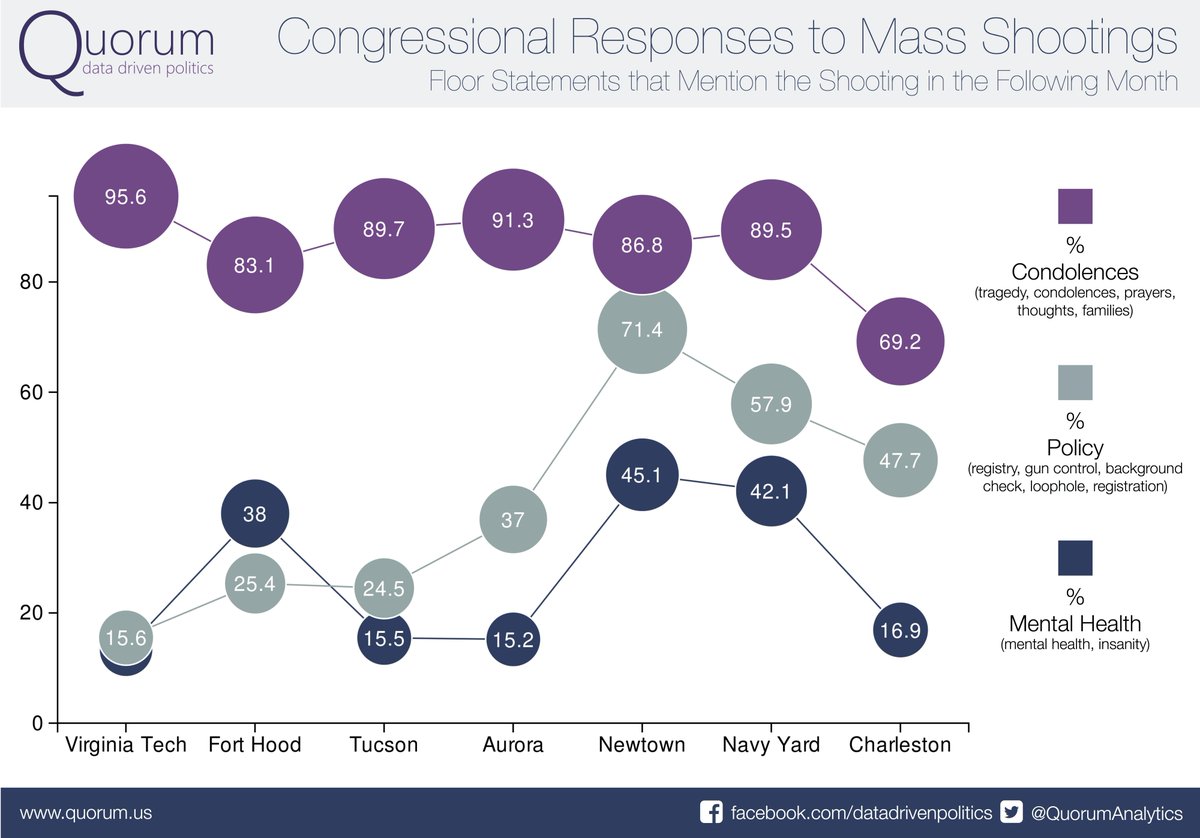
Quorum visualized the congressional response to major shootings over the past several years:

Embedded image permalink

That data show that congressional mentions of mass shootings in the context of gun control and mental health issues peaked after the late-2012 massacre in Newtown, Conn., when the White House unsuccessfully pushed for increased background checks for gun purchases.
Republicans and Democrats do differ on the issue of guns, at least, in how they talk about it:

Democrats and Republicans use very different words when talking about guns


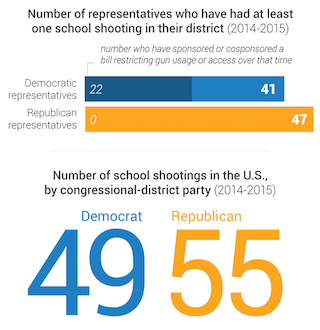
Meanwhile, a National Journal article looked at the congressional response by tallying up the number of bills addressing gun usage and access passed in the wake of school shootings:


What about state legislation?

The death rate in Oregon is 11.8 per 100,000 people, which puts it right in the middle of the range for all U.S. states, according to data from the Centers for Disease Control and Prevention and National Center for Health Statistics.
Among the states with the lowest death rates from firearms are Massachusetts, New York, Connecticut, and Hawaii.
A graphic in the National Journal explains why that might be: those same states have the most gun laws.

Embedded image permalink

The states with the most gun laws see the fewest gun-related deaths

Saturday, October 3, 2015

Another secret agreement???

Did Barack do yet another secret agreement?  Did he agree to vacate Guantanamo and not tell the American people?


Up to 10 U.S. Department of Defense officers will visit Colorado in the next two weeks to determine the suitability of transferring detainees from Guantanamo Bay to prisons in Florence and Cañon City.
"The Department of Defense notified Congress today that it will undertake additional site surveys within the next few weeks at Colorado State Penitentiary II," said Cmdr. Gary Ross of the U.S. Navy, a Department of Defense spokesman.
The federal officers will be looking at a medium-security prison in the federal complex in Florence and a vacant, maximum-security state prison in Cañon City.
Officials did not say how many Guantanamo detainees would be under consideration for transfer to Colorado, but dozens remain at the U.S. base in Cuba.
U.S. Sen. Cory Gardner, R-Colo., strongly objects to the plan to bring detainees to Colorado.
WATCH: Dept. of Defense considering two Colorado prisons to house Guantanamo Bay detainees and more
"I remain opposed to any plan to bring Guantanamo terrorists to Colorado," Gardner said in a statement. "I call on the Obama Administration to immediately halt any consideration of this irresponsible idea."
U.S. Sen. Bennet, D-Colo., also raised objections.
"The Department of Defense has no authority to transfer these prisoners or make such modifications and they have made no case that it makes sense to do so," Bennet said in a statement.
Gov. John Hickenlooper said he wants to have a full understanding of the costs, risk and impacts for Colorado. At present, there are no plans, nor is it legal under federal law, to move detainees to the U.S., he said in a statement.
One of the options is to house inmates at Colorado State Penitentiary II, or Centennial South Correctional Facility.
The prison, completed in 2010, was mothballed in 2012 following a change in policy that dramatically decreased the number of inmates held in maximum-security state facilities.
"We have certainly been looking for something to do with that empty prison," said Adrienne Jacobson, spokeswoman for the Colorado Department of Corrections. "We continue to pay for it."
The prison, which has 948 single-bed cells, cost $208 million. Annual payments are $20 million, she said.
The other option is to put Guantanamo Bay inmates at Federal Correctional Institute Florence, which currently holds more than 1,000 inmates.
The medium-security prison is in the same complex as Administrative Maximum Penitentiary, often called the Alcatraz of the Rockies or Supermax, which is the highest security prison in the federal prison system. It houses terrorists including Zacarias Moussaoui, a 9/11 conspirator; Faisal Shahzad, linked to the 2010 Times Square car bombing attempt; and Ramzi Yousef, the mastermind of the 1993 World Trade Center bombing.
Ross said the team will assess potential locations for holding a limited number of current Guantanamo detainees in the United States, and to assess the costs associated with doing so.
Currently there are 114 detainees remaining at Guantanamo Bay. Of those, 53 are earmarked for transfer to other countries. Most of the remaining 61 have also been approved for transfer to other countries, but arrangements have not been made for their transfer, Ross said.
"We are in the process of looking for a suitable country to send most of the detainees," Ross said. "Ten of the detainees are facing criminal charges for alleged terrorist acts."
A DoD team visited the Disciplinary Barracks at Fort Leavenworth, Kan. in August, and the Naval Consolidated Brig in Charleston, S.C. in September as part of the review, Ross said.
"The process to find a suitable location is complex and time consuming," he said. "We want to complete the plan as soon as possible and propose a plan for closing Guantanamo Bay."

http://www.denverpost.com/news/ci_28912665/u-s-officials-consider-colorados-supermax-terrorism-detainees


The citizens of Colorado do not want them here yet the administration seems to want to shove them down our throats.   The president with hos own agenda marches ahead in spite of what the people want.  Consider the other implications, they will now be subject to the US court systems and possibly released in America.

Obama says, SCREW YOU AMERICA, I CAN DO WHAT I WANT AND YOU CANNOT DO ANYTHING ABOUT IT.


Apcolypse Now

http://theweek.com/articles/580740/ben-carson-ready-coming-american-apocalypse

Friday, October 2, 2015

An Interesting if disheartening view of Americas future.... From Charles Hughs Smith

You Can't Separate Empire, the State, Financialization and Crony Capitalism: It's One Indivisible System

October 1, 2015
The great irony is what's unsustainable melts into thin air no matter how many people want it to keep going.
 
Disagreement is part of discourse, and pursuing differing views of the best way forward is the heart of democracy. Disagreement is abundant, democracy is scarce, despite claims to the contrary.
If you think you can surgically extract Empire from the American System, force the State to serve the working/middle classes, end the stripmining of financialization, limit crony capitalism/regulatory capture and get Big Money out of politics--go ahead and do so. I'm not standing in your way--go for it.

But while you pursue your good governance, populist, Left/ Right /Socialist/ Libertarian, etc. reforms, please understand the system is indivisible: the Deep State, the Imperial Project (hegemony and power projection), the State, finance in all its tenacled control mechanisms (greetings, debt-serfs and student-loan-serfs), crony capitalism /regulatory capture, money buying political influence, media propaganda passing as "news", and the evisceration of democracy (something untoward could happen if the serfs could overthrow the Power Elite at the ballot box--can't let that happen)--it's all one system.
 
Should any one organ be ripped from the body, the entire body dies. The entire system defends each subsystem as integral as a matter of survival. As a result, the naive notion that big money can be excised with only positive consequences is false: restoring democracy places the entire system at risk of implosion.

No more bread and circuses, no more Social Security checks, no more state employee pensions--it all melts into air if any subsystem stops doing its job.

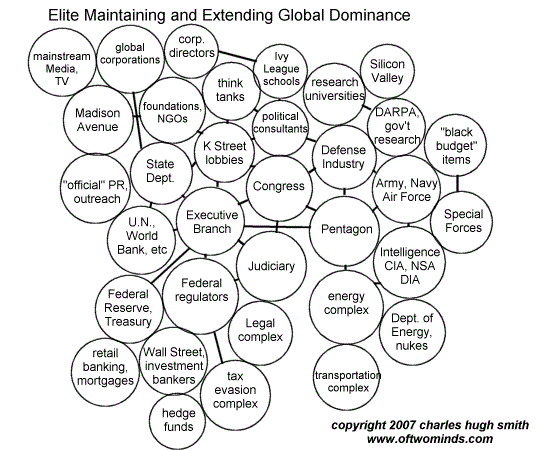
The system is interdependent. Each subsystem needs the others to function. I drew up a chart of the major components (but by no means all) of the system:


The system is a machine in which each gear serves the whole. So go ahead and try to "reform" the system by extracting whatever gear you don't approve of: the Deep State components, the Security State organs, the Federal Reserve, cartels/monopolies enforced by the State, the suppression of democracy, crony capitalism, whatever.

The machine will resist your "reform" to the death because should you succeed, the machine will implode. Take out the financialization gear and the financial system collapses.

So go ahead and reform to your heart's content. Go ahead and believe the system is reformable, if it makes you feel better. Vote for Bernie or The Donald or whomever. Go ahead and disagree with me. Prove me wrong. Prove the State really, really, really wants to serve the working/middle class rather than the Empire that it is. Pursue your Left/ Right/ Socialist/ Libertarian fantasies of righting the Imperial Project by ripping the gears out of the very center of the machine.

It doesn't work that way. We can't remove the gears we find distasteful. Either the machine grinds on and we get our share of the swag--bread and circuses, corporate welfare, State jobs and pensions, Medicaid and Medicare, and all the rest of the immense swag of hegemony and the Imperial Project--or the system implodes and all the swag melts into air.

The great irony is what's unsustainable melts into thin air no matter how many people want it to keep going.

But go ahead and disagree. It's your right, by golly. Go ahead and try to "reform" the system and see how far you get.


 http://www.oftwominds.com/blogoct15/one-system10-15.html

Thursday, October 1, 2015

Declining Student Resilience: A Serious Problem for Colleges

A year ago I received an invitation from the head of Counseling Services at a major university to join faculty and administrators for discussions about how to deal with the decline in resilience among students. At the first meeting, we learned that emergency calls to Counseling had more than doubled over the past five years. Students are increasingly seeking help for, and apparently having emotional crises over, problems of everyday life. Recent examples mentioned included a student who felt traumatized because her roommate had called her a “bitch” and two students who had sought counseling because they had seen a mouse in their off-campus apartment. The latter two also called the police, who kindly arrived and set a mousetrap for them.

Faculty at the meetings noted that students’ emotional fragility has become a serious problem when in comes to grading. Some said they had grown afraid to give low grades for poor performance, because of the subsequent emotional crises they would have to deal with in their offices. Many students, they said, now view a C, or sometimes even a B, as failure, and they interpret such “failure” as the end of the world. Faculty also noted an increased tendency for students to blame them (the faculty) for low grades—they weren’t explicit enough in telling the students just what the test would cover or just what would distinguish a good paper from a bad one. They described an increased tendency to see a poor grade as reason to complain rather than as reason to study more, or more effectively. Much of the discussions had to do with the amount of handholding faculty should do versus the degree to which the response should be something like, “Buck up, this is college.” Does the first response simply play into and perpetuate students’ neediness and unwillingness to take responsibility? Does the second response create the possibility of serious emotional breakdown, or, who knows, maybe even suicide?

Two weeks ago, that head of Counseling sent us all a follow-up email, announcing a new set of meetings. His email included this sobering paragraph:
“I have done a considerable amount of reading and research in recent months on the topic of resilience in college students. Our students are no different from what is being reported across the country on the state of late adolescence/early adulthood. There has been an increase in diagnosable mental health problems, but there has also been a decrease in the ability of many young people to manage the everyday bumps in the road of life. Whether we want it or not, these students are bringing their struggles to their teachers and others on campus who deal with students on a day-to-day basis. The lack of resilience is interfering with the academic mission of the University and is thwarting the emotional and personal development of students.”
He also sent us a summary of themes that emerged in the series of meetings, which included the following bullets:
  • Less resilient and needy students have shaped the landscape for faculty in that they are expected to do more handholding, lower their academic standards, and not challenge students too much.
  • There is a sense of helplessness among the faculty. Many faculty members expressed their frustration with the current situation. There were few ideas about what we could do as an institution to address the issue.
  • Students are afraid to fail; they do not take risks; they need to be certain about things. For many of them, failure is seen as catastrophic and unacceptable. External measures of success are more important than learning and autonomous development.
  • Faculty, particularly young faculty members, feel pressured to accede to student wishes lest they get low teacher ratings from their students. Students email about trivial things and expect prompt replies.
  • Failure and struggle need to be normalized. Students are very uncomfortable in not being right. They want to re-do papers to undo their earlier mistakes. We have to normalize being wrong and learning from one’s errors.
  • Faculty members, individually and as a group, are conflicted about how much “handholding” they should be doing.
  • Growth is achieved by striking the right balance between support and challenge. We need to reset the balance point. We have become a “helicopter institution.”
Reinforcing the claim that this is a nationwide problem, the Chronicle of Higher Education recently ran an article by Robin Wilson entitled, “An Epidemic of Anguish: Overwhelmed by Demand for Mental-Health Care, Colleges Face Conflicts in Choosing How to Respond" (Aug. 31, 2015). Colleges and universities have traditionally been centers for higher academic education, where the expectation is that the students are adults, capable of taking care of their own everyday life problems.  Increasingly, students and their parents are asking the personnel at such institutions to be substitute parents. There is also the ever-present threat and reality of lawsuits.  When a suicide occurs, or a serious mental breakdown occurs, the institution is often held responsible.
On the basis of her interviews with heads of counseling offices at various colleges and universities, Wilson wrote:
“Families often expect campuses to provide immediate, sophisticated, and sustained mental-health care. After all, most parents are still adjusting to the idea that their children no longer come home every night, and many want colleges to keep an eye on their kids, just as they did. Students, too, want colleges to give them the help they need, when they need it. And they need a lot. Rates of anxiety and depression among American college students have soared in the last decade, and many more students than in the past come to campus already on medication for such illnesses. The number of students with suicidal thoughts has risen as well. Some are dealing with serious issues, such as psychosis, which typically presents itself in young adulthood, just when students are going off to college. Many others, though, are struggling with what campus counselors say are the usual stresses of college life: bad grades, breakups, being on their own for the first time. And they are putting a strain on counseling centers.”
In previous posts (for example, here and here), I have described the dramatic decline, over the past few decades, in children’s opportunities to play, explore, and pursue their own interests away from adults. Among the consequences, I have argued, are well-documented increases in anxiety and depression, and decreases in the sense of control of their own lives. We have raised a generation of young people who have not been given the opportunity to learn how to solve their own problems. They have not been given the opportunity to get into trouble and find their own way out, to experience failure and realize they can survive it, to be called bad names by others and learn how to respond without adult intervention. So now, here’s what we have: Young people,18 years and older, going to college still unable or unwilling to take responsibility for themselves, still feeling that if a problem arises they need an adult to solve it.

Dan Jones, past president of the Association for University and College Counseling Center Directors, seems to agree with this assessment. In an interview for the Chronicle article, he said:
“[Students] haven’t developed skills in how to soothe themselves, because their parents have solved all their problems and removed the obstacles. They don’t seem to have as much grit as previous generations.”
In my next post I’ll examine the research evidence suggesting that so-called “helicopter parenting” really is at the core of the problem. But I don’t blame parents, or certainly not just parents. Parents are in some ways victims of larger forces in society—victims of the continuous exhortations from “experts” about the dangers of letting kids be, victims of the increased power of the school system and the schooling mentality that says kids develop best when carefully guided and supervised by adults, and victims of increased legal and social sanctions for allowing kids into public spaces without adult accompaniment. We have become, unfortunately, a “helicopter society.”
If we want to prepare our kids for college—or for anything else in life!—we have to counter these social forces. We have to give our children the freedom, which children have always enjoyed in the past, to get away from adults so they can practice being adults—that is, practice taking responsibility for themselves.

And now, what do you think? 
Have you witnessed in any way the kinds of changes in young adults described here and that seem to be plaguing colleges and universities? How have you, as a parent, negotiated the line between protecting your children and giving them the freedom they need for psychological growth? Do you have any suggestions for college counselors and professors about how to deal with these problems they are struggling with?
I invite you to share your stories, thoughts, and questions in the comments section below. This blog is, among other things, a forum for discussion. As always, I prefer if you post your comments and questions here rather than send them to me by private email. By putting them here, you share with other readers, not just with me. I read all comments and try to respond to all serious questions if I think I have something worth saying. Of course, if you have something to say that applies only to you and me, then send me an email.

Posted Below are some of the comments this article received...


I would guess a portion (if not a lot) of this emotional volatility on the part of students comes from anxiety about the lack of economic opportunities that students continue to face post-college. Competitiveness of grad school admissions, and for decent jobs in general is up significantly.
This makes students much more anxious in general, and can make small issues seem like larger problems. You don't just graduate college and find a decent paying job anymore.

Gretchen, I teach middle school as well and I had the same thought as I was reading this. I try to let students fail but administration steps in and I am given "suggestions" on how to help my students succeed. The politics in the school, to meet goals, is making it difficult for teachers, to allow students to learn what success really can be for them.

I agree. I used to be a middle-school teacher as well. Although my class was easy to pass if you did the work, some students chose not to do the work, and chose to fail instead. I figured it was a learning experience.
Nope.
The admin stepped in and "suggested" I change the students grades by allowing them a few weeks after the report card to "make up" the work they chose not to complete. I told them to do as they saw fit, and I left that school at the end of the year.

The "make-up" work expectation is damaging. Students are taught, artificially, that time can be undone by not being allowed to experience the natural consequences of their actions. Only when they feel the consequences do they want to change their ways, and are thus taught to live backwards rather than forwards. They learn the false lesson that life provides them with perpetually do-overs. The administration is just interested in doing whatever it takes to get the students through and achieve the targets they are accountable for.

Make ups and do overs are common in the working world. If it isn't right then work all night and get it done the way the customer wants. Some if this is okay to allow for.

I teach college and the same problem you mention continues; namely that students are not allowed to fail because admin intervenes- generally invited by the student as they file a complaint that they should have gotten a better grade. The solution is simple and obvious- allow failing students to fail. Trust the authority of the instructor, whether in junior high school or college. Although this will be a giant revelation to admin, college professors and middle school teachers know what they are doing, they know A LOT more than whiny students, and greed over tuition money should not be the top priority in considering student advancement through the curriculum.

Its not that students are not allowed to fail that causes such psychological fragility, it is perhaps more caused by a constant reminder of the negative consequences of failing. The culture of education in the US is so predicated on grading, testing, and benchmarking that students become products of University stress. Competition for the "best" students is driven by scores, parents only know how to understand the "intelligence" of their children by what their report card says, and students under that pressure will conform to whatever they have to in order to become "successful". Educators, universities, parents, and students are spending all their energy caring about the wrong things (first grades, then SAT, then admission to college, then marketablility and employment, or grad school appilcation... ), and their is no energy left (IN SCHOOLS or teachers) to pursue truly meaningful and engaging forms of learning that help students to become resilient/self-motivated learners.
Check out the book "Dumbing us Down" by Gatto.

I worked as a sub at a school and at one point had a long term sub gig for middle/high school where I was responsible for the entire grading period. A student from the Gifted/Talented program was getting a C in one of my classes (and getting blown out of the water by two students a grade behind him) and the VP tried to pressure me to find a way to boost him from 77% to a B. He was being rather subtle and I wasn't 'getting it'; when he finally came out and asked I asked him if that would be ethical. The subject was dropped. I suspected that they would change the grade after I had posted them, but found out later that it stood. I was a bit surprised.
Unfortunately, I lost his mother as a friend (very small community) for a while... until the teacher who came in full time behind me held him to standards also. He just didn't want to do the homework - and when his test grades matched his homework effort, it showed.

 I recently listened to a lecture given by a Professor at George Mason U. .. Dr. Walter Williams.  He is very much against the effects of most social programs pointed at uplifting blacks.  He said the their is two problems occurring in black schools that are turning out High School graduates with 8th grade skills.  One is the social stigma around failure and the other is that even if a school is administered by blacks and taught by blacks, failing students is seen as oppression.

I am particularly interested in your views Mick with regard to methods and the results we seem to be seeing not only in school but in society at large.


Wednesday, September 30, 2015

No Shutdown

WASHINGTON, Sept 30 (Reuters) - The U.S. Congress, ending weeks of infighting, gave final approval on Wednesday to a bill funding the government through Dec. 11 and averting agency shutdowns that would have otherwise begun on Thursday with the start of a new fiscal year.
By a vote of 277-151, the House approved the stopgap spending bill and will now send it to President Barack Obama for signing into law before a midnight deadline.
House Speaker John Boehner, who is resigning on Oct. 30, needed significant support from Democrats to pass the bill as a majority of his fellow Republicans voted against the measure. (Reporting By Richard Cowan; Editing by Sandra Maler)