Wednesday, October 14, 2015
Grading the First Democratic Debate
http://www.bloomberg.com/politics/articles/2015-10-14/grading-the-democratic-debate-hillary-clinton-schools-her-rivals

This should stir William's soul
The Republican 'Freedom Caucus' Is Un-American

There's a stunning unreality to the right-wing attack on John Boehner as insufficiently conservative. On issues like economic policy, abortion, guns, Obamacare, gay marriage, immigration, you-name-it Boehner is in perfect right-wing harmony with the most reactionary of his Members. Indeed, the entire Republican House Majority is in lock-step about everything. The Republican Party has purged itself of ideological dispute. It is a single, hard-right voice.
Then what happened to Boehner? To answer that you need to read your Alexander Hamilton and James Madison, Federalist Paper Number 10: "some of the distresses under which we labor have been erroneously charged on the operation of our Governments;...[rather the] increasing distrust of public engagements [are the] effects of...a factious spirit [which] has tainted our public administrations. A zeal for different opinions concerning religion, concerning Government; an attachment to different leaders ambitiously contending for preëminence and power...have, in turn, divided mankind into parties, inflamed them with mutual animosity, and rendered them much more disposed to vex and oppress each other, than to coöperate for their common good."
The danger, sayeth the Founders, is not disagreement on policy, it is factions unwilling to cooperate. So it is with the House Republicans and the "Freedom Caucus" which drove Boehner out of the Speaker's chair. These folks are entitled to their policy views. The real question is whether they will be able to shut down the government because they haven't sufficient votes to enact them through democratic means.
Be it Planned Parenthood or immigration or Obamacare the central objection to Boehner from the Freedom Caucus is that he compromised, and was insufficiently militant. Boehner's response is to point to the undeniable fact that the Senate has insufficient votes to adopt the Freedom Caucus agenda, the President will veto and the override votes aren't there in either house. No matter says the Freedom Caucus. We must shut down the government if that is what it takes to get our way.
Again, this isn't a policy dispute. It's about tactics. I spent close to thirty years in a legislative body, and I will tell you that American democracy is not designed for speed, efficiency or clear-cut wins. It is about the development of consensus and compromise. The Founders produced a Constitution that carefully separates power and makes it harder to function. The Speaker of the House is not a Prime Minister, not a dictator. To govern otherwise is un-American.
You would think that the Freedom Caucus would be willing to put things to a vote of the whole Congress. No. They do not accept the notion of bi-partisan majorities governing. Their policies must become law, their leaders and the views of the majority be damned.
There is more at stake for all of us than the name and ideology of the next Speaker. There is a struggle for the soul of American democracy. We are being required to re-examine our basic commitment to constitutional government. We are deciding whether a faction, numbering less than 40 of 535 elected representatives, can do to the Constitution what civil war, economic collapse, and enormous social change was never able to do: Undo the basic understanding of how we govern ourselves.
Madison and Hamilton knew what they were talking about, and knew that faction and democracy cannot co-exist. The responsibility for sorting this out now falls on a Republican Party that seems not to know itself or the country, either in Congress or in the battle for the Presidential nomination. There is no reason to believe that things will come out well.
standing them up!
Vietnamization 2.0
Andrew Bacevich
Bremer’s best-laid plans imploded as an insurgency blossomed from the roiling mass of well-trained Iraqi military veterans he had ushered to the unemployment line and a civil war soon wracked the country. A bloodbath ensued and never ended, even as the U.S. surged in more troops and pumped in tens of billions of dollars to build what eventually became the 930,000-man strong Iraqi security forces. (That’s not much smaller than the South Vietnamese Army the U.S. built up in the late 1960s!) Along the way, there was plenty of progress. “Every single day, the Iraqi security forces are getting bigger and better and better trained and better equipped and more experienced,” said Defense Secretary Donald Rumsfeld in 2005. “You know, the one thing -- the one thing we have seen is that Iraq has developed a very good capability to be able to defend itself,” said Secretary of Defense Leon Panetta six years later. “And I think that's a reflection of the fact that the Iraqis have developed a very important capability here to be able to respond to security threats within their own country.”
And yet by 2014, the Iraqi military had (and was paying) more ghost soldiers -- troops who existed only on paper -- than the number of real soldiers Bremer had envisioned to secure the whole country back in 2003. As it happened, Iraq was anything but secure. Today, it’s a half-failed state, riven by sectarian strife, and has lost a significant portion of its territory to an extremist group incubated in U.S. prison camps. The country is now far worse off than the one the U.S. invaded in 2003.
The U.S. military is great at a lot of things, just not things like winning wars or effectively training foreign forces. TomDispatch regular Andrew Bacevich takes on the how-and-why of this latter failure, tracing the sorry history of U.S. nation- and army-building from the battlefields of Vietnam -- which he knew intimately -- to the festering wars of today. Buckle up for a long, strange trip.
On Building Armies (and Watching Them Fail)
Why Washington Can’t “Stand Up” Foreign Militaries
First came Fallujah, then Mosul, and later Ramadi in Iraq. Now, there is Kunduz, a provincial capital in northern Afghanistan. In all four places, the same story has played out: in cities that newspaper reporters like to call “strategically important,” security forces trained and equipped by the U.S. military at great expense simply folded, abandoning their posts (and much of their U.S.-supplied weaponry) without even mounting serious resistance. Called upon to fight, they fled. In each case, the defending forces gave way before substantially outnumbered attackers, making the outcomes all the more ignominious.
Together, these setbacks have rendered a verdict on the now more-or-less nameless Global War on Terrorism (GWOT). Successive blitzkriegs by ISIS and the Taliban respectively did more than simply breach Iraqi and Afghan defenses. They also punched gaping holes in the strategy to which the United States had reverted in hopes of stemming the further erosion of its position in the Greater Middle East.
Recall that, when the United States launched its GWOT soon after 9/11, it did so pursuant to a grandiose agenda. U.S. forces were going to imprint onto others a specific and exalted set of values. During President George W. Bush’s first term, this “freedom agenda” formed the foundation, or at least the rationale, for U.S. policy.
The shooting would stop, Bush vowed, only when countries like Afghanistan had ceased to harbor anti-American terrorists and countries like Iraq had ceased to encourage them. Achieving this goal meant that the inhabitants of those countries would have to change. Afghans and Iraqis, followed in due course by Syrians, Libyans, Iranians, and sundry others would embrace democracy, respect human rights, and abide by the rule of law, or else. Through the concerted application of American power, they would become different -- more like us and therefore more inclined to get along with us. A bit less Mecca and Medina, a bit more “we hold these truths” and “of the people, by the people.”
So Bush and others in his inner circle professed to believe. At least some of them, probably including Bush himself, may actually have done so.
History, at least the bits and pieces to which Americans attend, seemed to endow such expectations with a modicum of plausibility. Had not such a transfer of values occurred after World War II when the defeated Axis Powers had hastily thrown in with the winning side? Had it not recurred as the Cold War was winding down, when previously committed communists succumbed to the allure of consumer goods and quarterly profit statements?
If the appropriate mix of coaching and coercion were administered, Afghans and Iraqis, too, would surely take the path once followed by good Germans and nimble Japanese, and subsequently by Czechs tired of repression and Chinese tired of want. Once liberated, grateful Afghans and Iraqis would align themselves with a conception of modernity that the United States had pioneered and now exemplified. For this transformation to occur, however, the accumulated debris of retrograde social conventions and political arrangements that had long retarded progress would have to be cleared away. This was what the invasions of Afghanistan (Operation Enduring Freedom!) and Iraq (Operation Iraqi Freedom!) were meant to accomplish in one fell swoop by a military the likes of which had (to hear Washington tell it) never been seen in history. POW!
Standing Them Up As We Stand Down
Concealed within that oft-cited “freedom” -- the all-purpose justification for deploying American power -- were several shades of meaning. The term, in fact, requires decoding. Yet within the upper reaches of the American national security apparatus, one definition takes precedence over all others. In Washington, freedom has become a euphemism for dominion. Spreading freedom means positioning the United States to call the shots. Seen in this context, Washington’s expected victories in both Afghanistan and Iraq were meant to affirm and broaden its preeminence by incorporating large parts of the Islamic world into the American imperium. They would benefit, of course, but to an even greater extent, so would we.
Alas, liberating Afghans and Iraqis turned out to be a tad more complicated than the architects of Bush’s freedom (or dominion) agenda anticipated. Well before Barack Obama succeeded Bush in January 2009, few observers -- apart from a handful of ideologues and militarists -- clung to the fairy tale of U.S. military might whipping the Greater Middle East into shape. Brutally but efficiently, war had educated the educable. As for the uneducable, they persisted in taking their cues from Fox News and the Weekly Standard.
Yet if the strategy of transformation via invasion and “nation building” had failed, there was a fallback position that seemed to be dictated by the logic of events. Together, Bush and Obama would lower expectations as to what the United States was going to achieve, even as they imposed new demands on the U.S. military, America’s go-to outfit in foreign policy, to get on with the job.
Rather than midwifing fundamental political and cultural change, the Pentagon was instead ordered to ramp up its already gargantuan efforts to create local militaries (and police forces) capable of maintaining order and national unity. President Bush provided a concise formulation of the new strategy: “As the Iraqis stand up, we will stand down.” Under Obama, after his own stab at a “surge,” the dictum applied to Afghanistan as well. Nation-building had flopped. Building armies and police forces able to keep a lid on things now became the prevailing definition of success.
The United States had, of course, attempted this approach once before, with unhappy results. This was in Vietnam. There, efforts to destroy North Vietnamese and Viet Cong forces intent on unifying their divided country had exhausted both the U.S. military and the patience of the American people. Responding to the logic of events, Presidents Lyndon Johnson and Richard Nixon had a tacitly agreed upon fallback position. As the prospects of American forces successfully eliminating threats to South Vietnamese security faded, the training and equipping of the South Vietnamese to defend themselves became priority number one.
Dubbed “Vietnamization,” this enterprise ended in abject failure with the fall of Saigon in 1975. Yet that failure raised important questions to which members of the national security elite might have attended: Given a weak state with dubious legitimacy, how feasible is it to expect outsiders to invest indigenous forces with genuine fighting power? How do differences in culture or history or religion affect the prospects for doing so? Can skill ever make up for a deficit of will? Can hardware replace cohesion? Above all, if tasked with giving some version of Vietnamization another go, what did U.S. forces need to do differently to ensure a different result?
At the time, with general officers and civilian officials more inclined to forget Vietnam than contemplate its implications, these questions attracted little attention. Instead, military professionals devoted themselves to gearing up for the next fight, which they resolved would be different. No more Vietnams -- and therefore no more Vietnamization.
After the Gulf War of 1991, basking in the ostensible success of Operation Desert Storm, the officer corps persuaded itself that it had once and for all banished its Vietnam-induced bad memories. As Commander-in-Chief George H.W. Bush so memorably put it, “By God, we've kicked the Vietnam syndrome once and for all.”
In short, the Pentagon now had war figured out. Victory had become a foregone conclusion. As it happened, this self-congratulatory evaluation left U.S. troops ill-prepared for the difficulties awaiting them after 9/11 when interventions in Afghanistan and Iraq departed from the expected script, which posited short wars by a force beyond compare ending in decisive victories. What the troops got were two very long wars with no decision whatsoever. It was Vietnam on a smaller scale all over again -- times two.
Vietnamization 2.0
For Bush in Iraq and Obama after a brief, half-hearted flirtation with counterinsurgency in Afghanistan, opting for a variant of Vietnamization proved to be a no-brainer. Doing so offered the prospect of an escape from all complexities. True enough, Plan A -- we export freedom and democracy -- had fallen short. But Plan B -- they (with our help) restore some semblance of stability -- could enable Washington to salvage at least partial success in both places. With the bar suitably lowered, a version of “Mission Accomplished” might still be within reach.
If Plan A had looked to U.S. troops to vanquish their adversaries outright, Plan B focused on prepping besieged allies to take over the fight. Winning outright was no longer the aim -- given the inability of U.S. forces to do so, this was self-evidently not in the cards -- but holding the enemy at bay was.
Although allied with the United States, only in the loosest sense did either Iraq or Afghanistan qualify as a nation-state. Only nominally and intermittently did governments in Baghdad and Kabul exercise a writ of authority commanding respect from the people known as Iraqis and Afghans. Yet in the Washington of George Bush and Barack Obama, a willing suspension of disbelief became the basis for policy. In distant lands where the concept of nationhood barely existed, the Pentagon set out to create a full-fledged national security apparatus capable of defending that aspiration as if it represented reality. From day one, this was a faith-based undertaking.
As with any Pentagon project undertaken on a crash basis, this one consumed resources on a gargantuan scale -- $25 billion in Iraq and an even more staggering $65 billion in Afghanistan. “Standing up” the requisite forces involved the transfer of vast quantities of equipment and the creation of elaborate U.S. training missions. Iraqi and Afghan forces acquired all the paraphernalia of modern war -- attack aircraft or helicopters, artillery and armored vehicles, night vision devices and drones. Needless to say, stateside defense contractors lined up in droves to cash in.Together, these setbacks have rendered a verdict on the now more-or-less nameless Global War on Terrorism (GWOT). Successive blitzkriegs by ISIS and the Taliban respectively did more than simply breach Iraqi and Afghan defenses. They also punched gaping holes in the strategy to which the United States had reverted in hopes of stemming the further erosion of its position in the Greater Middle East.
Recall that, when the United States launched its GWOT soon after 9/11, it did so pursuant to a grandiose agenda. U.S. forces were going to imprint onto others a specific and exalted set of values. During President George W. Bush’s first term, this “freedom agenda” formed the foundation, or at least the rationale, for U.S. policy.
The shooting would stop, Bush vowed, only when countries like Afghanistan had ceased to harbor anti-American terrorists and countries like Iraq had ceased to encourage them. Achieving this goal meant that the inhabitants of those countries would have to change. Afghans and Iraqis, followed in due course by Syrians, Libyans, Iranians, and sundry others would embrace democracy, respect human rights, and abide by the rule of law, or else. Through the concerted application of American power, they would become different -- more like us and therefore more inclined to get along with us. A bit less Mecca and Medina, a bit more “we hold these truths” and “of the people, by the people.”
So Bush and others in his inner circle professed to believe. At least some of them, probably including Bush himself, may actually have done so.
History, at least the bits and pieces to which Americans attend, seemed to endow such expectations with a modicum of plausibility. Had not such a transfer of values occurred after World War II when the defeated Axis Powers had hastily thrown in with the winning side? Had it not recurred as the Cold War was winding down, when previously committed communists succumbed to the allure of consumer goods and quarterly profit statements?
If the appropriate mix of coaching and coercion were administered, Afghans and Iraqis, too, would surely take the path once followed by good Germans and nimble Japanese, and subsequently by Czechs tired of repression and Chinese tired of want. Once liberated, grateful Afghans and Iraqis would align themselves with a conception of modernity that the United States had pioneered and now exemplified. For this transformation to occur, however, the accumulated debris of retrograde social conventions and political arrangements that had long retarded progress would have to be cleared away. This was what the invasions of Afghanistan (Operation Enduring Freedom!) and Iraq (Operation Iraqi Freedom!) were meant to accomplish in one fell swoop by a military the likes of which had (to hear Washington tell it) never been seen in history. POW!
Standing Them Up As We Stand Down
Concealed within that oft-cited “freedom” -- the all-purpose justification for deploying American power -- were several shades of meaning. The term, in fact, requires decoding. Yet within the upper reaches of the American national security apparatus, one definition takes precedence over all others. In Washington, freedom has become a euphemism for dominion. Spreading freedom means positioning the United States to call the shots. Seen in this context, Washington’s expected victories in both Afghanistan and Iraq were meant to affirm and broaden its preeminence by incorporating large parts of the Islamic world into the American imperium. They would benefit, of course, but to an even greater extent, so would we.
Alas, liberating Afghans and Iraqis turned out to be a tad more complicated than the architects of Bush’s freedom (or dominion) agenda anticipated. Well before Barack Obama succeeded Bush in January 2009, few observers -- apart from a handful of ideologues and militarists -- clung to the fairy tale of U.S. military might whipping the Greater Middle East into shape. Brutally but efficiently, war had educated the educable. As for the uneducable, they persisted in taking their cues from Fox News and the Weekly Standard.
Yet if the strategy of transformation via invasion and “nation building” had failed, there was a fallback position that seemed to be dictated by the logic of events. Together, Bush and Obama would lower expectations as to what the United States was going to achieve, even as they imposed new demands on the U.S. military, America’s go-to outfit in foreign policy, to get on with the job.
Rather than midwifing fundamental political and cultural change, the Pentagon was instead ordered to ramp up its already gargantuan efforts to create local militaries (and police forces) capable of maintaining order and national unity. President Bush provided a concise formulation of the new strategy: “As the Iraqis stand up, we will stand down.” Under Obama, after his own stab at a “surge,” the dictum applied to Afghanistan as well. Nation-building had flopped. Building armies and police forces able to keep a lid on things now became the prevailing definition of success.
The United States had, of course, attempted this approach once before, with unhappy results. This was in Vietnam. There, efforts to destroy North Vietnamese and Viet Cong forces intent on unifying their divided country had exhausted both the U.S. military and the patience of the American people. Responding to the logic of events, Presidents Lyndon Johnson and Richard Nixon had a tacitly agreed upon fallback position. As the prospects of American forces successfully eliminating threats to South Vietnamese security faded, the training and equipping of the South Vietnamese to defend themselves became priority number one.
Dubbed “Vietnamization,” this enterprise ended in abject failure with the fall of Saigon in 1975. Yet that failure raised important questions to which members of the national security elite might have attended: Given a weak state with dubious legitimacy, how feasible is it to expect outsiders to invest indigenous forces with genuine fighting power? How do differences in culture or history or religion affect the prospects for doing so? Can skill ever make up for a deficit of will? Can hardware replace cohesion? Above all, if tasked with giving some version of Vietnamization another go, what did U.S. forces need to do differently to ensure a different result?
At the time, with general officers and civilian officials more inclined to forget Vietnam than contemplate its implications, these questions attracted little attention. Instead, military professionals devoted themselves to gearing up for the next fight, which they resolved would be different. No more Vietnams -- and therefore no more Vietnamization.
After the Gulf War of 1991, basking in the ostensible success of Operation Desert Storm, the officer corps persuaded itself that it had once and for all banished its Vietnam-induced bad memories. As Commander-in-Chief George H.W. Bush so memorably put it, “By God, we've kicked the Vietnam syndrome once and for all.”
In short, the Pentagon now had war figured out. Victory had become a foregone conclusion. As it happened, this self-congratulatory evaluation left U.S. troops ill-prepared for the difficulties awaiting them after 9/11 when interventions in Afghanistan and Iraq departed from the expected script, which posited short wars by a force beyond compare ending in decisive victories. What the troops got were two very long wars with no decision whatsoever. It was Vietnam on a smaller scale all over again -- times two.
Vietnamization 2.0
For Bush in Iraq and Obama after a brief, half-hearted flirtation with counterinsurgency in Afghanistan, opting for a variant of Vietnamization proved to be a no-brainer. Doing so offered the prospect of an escape from all complexities. True enough, Plan A -- we export freedom and democracy -- had fallen short. But Plan B -- they (with our help) restore some semblance of stability -- could enable Washington to salvage at least partial success in both places. With the bar suitably lowered, a version of “Mission Accomplished” might still be within reach.
If Plan A had looked to U.S. troops to vanquish their adversaries outright, Plan B focused on prepping besieged allies to take over the fight. Winning outright was no longer the aim -- given the inability of U.S. forces to do so, this was self-evidently not in the cards -- but holding the enemy at bay was.
Although allied with the United States, only in the loosest sense did either Iraq or Afghanistan qualify as a nation-state. Only nominally and intermittently did governments in Baghdad and Kabul exercise a writ of authority commanding respect from the people known as Iraqis and Afghans. Yet in the Washington of George Bush and Barack Obama, a willing suspension of disbelief became the basis for policy. In distant lands where the concept of nationhood barely existed, the Pentagon set out to create a full-fledged national security apparatus capable of defending that aspiration as if it represented reality. From day one, this was a faith-based undertaking.
Based on their performance, the security forces on which the Pentagon has lavished years of attention remain visibly not up to the job. Meanwhile, ISIS warriors, without the benefit of expensive third-party mentoring, appear plenty willing to fight and die for their cause. Ditto Taliban fighters in Afghanistan. The beneficiaries of U.S. assistance? Not so much. Based on partial but considerable returns, Vietnamization 2.0 seems to be following an eerily familiar trajectory that should remind anyone of Vietnamization 1.0. Meanwhile, the questions that ought to have been addressed back when our South Vietnamese ally went down to defeat have returned with a vengeance.
The most important of those questions challenges the assumption that has informed U.S. policy in the Greater Middle East since the freedom agenda went south: that Washington has a particular knack for organizing, training, equipping, and motivating foreign armies. Based on the evidence piling up before our eyes, that assumption appears largely false. On this score, retired Lieutenant General Karl Eikenberry, a former military commander and U.S. ambassador in Afghanistan, has rendered an authoritative judgment. “Our track record at building [foreign] security forces over the past 15 years is miserable,” he recently told the New York Times. Just so.
Fighting the Wrong War
Some might argue that trying harder, investing more billions, sending yet more equipment for perhaps another 15 years will produce more favorable results. But this is akin to believing that, given sufficient time, the fruits of capitalism will ultimately trickle down to benefit the least among us or that the march of technology holds the key to maximizing human happiness. You can believe it if you want, but it’s a mug’s game.
Indeed, the United States would be better served if policymakers abandoned the pretense that the Pentagon possesses any gift whatsoever for “standing up” foreign military forces. Prudence might actually counsel that Washington assume instead, when it comes to organizing, training, equipping, and motivating foreign armies, that the United States is essentially clueless.
Exceptions may exist. For example, U.S. efforts have probably helped boost the fighting power of the Kurdish peshmerga. Yet such exceptions are rare enough to prove the rule. Keep in mind that before American trainers and equipment ever showed up, Iraq’s Kurds already possessed the essential attributes of nationhood. Unlike Afghans and Iraqis, Kurds do not require tutoring in the imperative of collective self-defense.
What are the policy implications of giving up the illusion that the Pentagon knows how to build foreign armies? The largest is this: subletting war no longer figures as a plausible alternative to waging it directly. So where U.S. interests require that fighting be done, like it or not, we’re going to have to do that fighting ourselves. By extension, in circumstances where U.S. forces are demonstrably incapable of winning or where Americans balk at any further expenditure of American blood -- today in the Greater Middle East both of these conditions apply -- then perhaps we shouldn’t be there. To pretend otherwise is to throw good money after bad or, as a famous American general once put it, to wage (even if indirectly) “the wrong war, at the wrong place, at the wrong time, and with the wrong enemy." This we have been doing now for several decades across much of the Islamic world.
In American politics, we await the officeholder or candidate willing to state the obvious and confront its implications.
Tuesday, October 13, 2015
The End Of An Era
Playboy Magazine has announce they will no longer print pictures of nudes. What next?
http://www.bloomberg.com/news/articles/2015-10-13/end-of-playboy-nudes-shows-how-badly-publishers-need-facebook
http://www.bloomberg.com/news/articles/2015-10-13/end-of-playboy-nudes-shows-how-badly-publishers-need-facebook
Sunday, October 11, 2015
Planned Parenthood total partisan issue
Public narrowly against defunding Planned Parenthood
The public narrowly opposes defunding the organization and half the country has a positive view of Planned Parenthood
Americans generally like Planned Parenthood – at least they did before Republican presidential candidate Carly Fiorina raised the subject of the sting videos (showing Planned Parenthood leaders talking about the harvesting of fetal organs for research) at last week’s GOP presidential debate. Those videos once again focused attention on the Congressional attempt to defund Planned Parenthood, which may include the possibility of a government shutdown.The latest Economist/YouGov poll finds Americans narrowly oppose defunding Planned Parenthood. However, one in five Americans would support a government shutdown in order to defund the organization. Opinions are definitely partisan: nearly half of Republicans would shut down the government in order to defund Planned Parenthood. Just 8% of Democrats would.
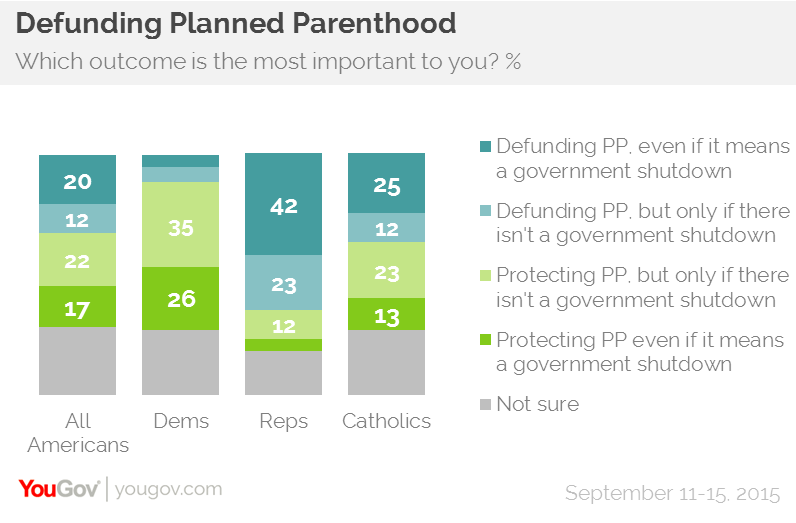
Fiorina’s comments also generated controversy over whether what she reported as seeing in the videos actually appeared in them. In this poll, viewers draw different conclusions based on their pre-existing opinions. In addition, groups that are opposed to abortion, like Republicans and conservatives, are more likely to have heard about the videos and more likely to have seen them. More Republicans than Democrats and more than twice as many conservatives than liberals have watched the videos.
The reaction to the videos among viewers also divides along those lines of party and ideology. More than three in four Republican and conservative viewers think the videos show that Planned Parenthood officials broke the law; an equivalent proportion of Democrats and liberals who have watched the video disagree.
For many in the overall public, Planned Parenthood is about something other than abortions. More than half associate the organization with contraception; more than four in ten with pregnancy testing, and more than a quarter each with testing for STDs and sex education. But 48% also associate Planned Parenthood with abortion services. For Republicans and conservatives, however, abortion services is the main mention of what Planned Parenthood does. There has not been much change in this assessment in the last few months.
And there continues to be little change in the overall opinion of Planned Parenthood. Although there was a slight increase in unfavorable opinions just after the videos emerged, there has been no change since then. More Americans have a favorable opinion than an unfavorable one, though partisan differences are large.


drug prices
Voters of all parties: let the federal government negotiate drug prices
 on
on
Nearly two-thirds of Americans support the federal government and insurers negotiating with drug companies to set prescription prices

Late last month a young businessman with a history of ruthless behavior shocked much of the country by hiking the price of a lifesaving drug by 4,000% overnight after he bought the rights to produce the drug. The move quickly attracted widespread attention, from industry reps who disowned the move to presidential candidate Hillary Clinton who promised to tackle similar price hikes if she became president. The price change highlights, however, that unlike patients in the rest of the developed world sick Americans are unusually vulnerable to the prices of drugs and many end up not taking necessary drugs because they cannot afford to.
The latest research from YouGov shows that the vast majority of Americans (78%) think it is wrong that people could go without necessary drugs because they cannot afford to pay for them, while only 10% think it is right. Only 13% of Republicans think that it is right that poorer people cannot afford their prescriptions, even though 50% of Republicans say that it is right that people with more money can buy themselves better healthcare, something 46% of the overall public thinks is wrong.
Under laws governing the prescription drug benefit for Medicare, the federal government is forbidden from negotiating over the price of drugs, rather they must pay the price drug companies name. A large majority of Americans (64%) support a proposal under which universal prescription drug prices would be set through negotiations between the federal government and health insurance companies on the one hand, and the drug manufacturers on the other hand. Support for the measure is bipartisan, as strong support among Democrats (76%) is matched by majority support among Republicans (57%).
Under laws governing the prescription drug benefit for Medicare, the federal government is forbidden from negotiating over the price of drugs, rather they must pay the price drug companies name. A large majority of Americans (64%) support a proposal under which universal prescription drug prices would be set through negotiations between the federal government and health insurance companies on the one hand, and the drug manufacturers on the other hand. Support for the measure is bipartisan, as strong support among Democrats (76%) is matched by majority support among Republicans (57%).


more liberal
Even conservatives expect America to become more liberal
Americans are divided on whether they want the country to become more conservative or more liberal, but even conservatives widely expect the country to
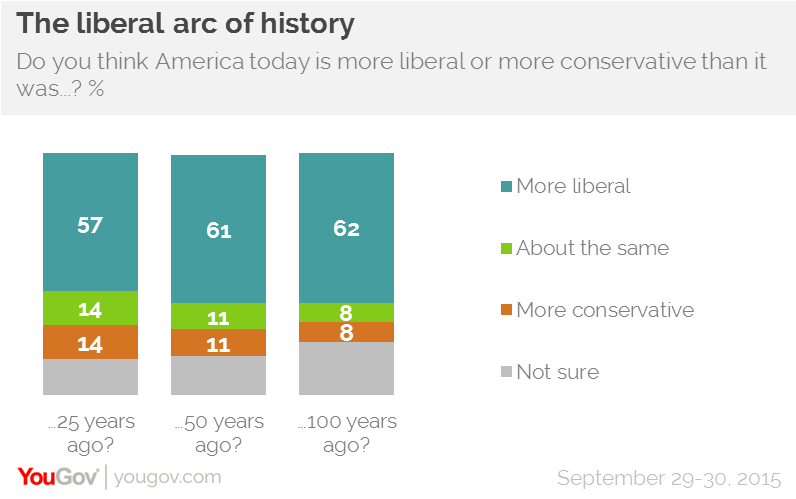
So far 2015 has undoubtedly been a good year for liberals. The Supreme Court has legalized same-sex marriage throughout the country and Obamacare is now almost totally implemented, while legal threats to the system have been struck down. Looking back just ten years to the apex of conservative power after George W. Bush's re-election, however, illustrates how quickly fortunes can change.
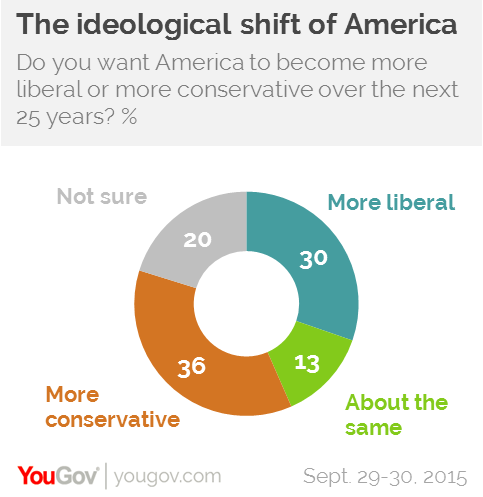
YouGov's latest research shows that few Americans (13%) want America to remain as it is today while two-thirds want the country to change. 36% of the country want America to become more conservative while 30% want the country to become more liberal. Unsurprisingly a large majority of Republicans (70%) want America to become more conservative, while just under half of Democrats (47%) want the country to become more liberal.
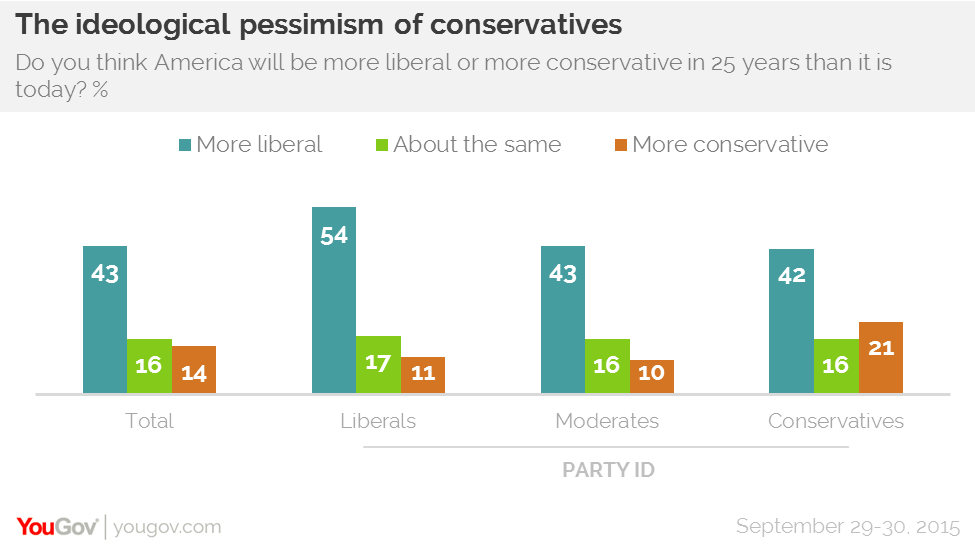
Despite the differences on the desired trajectory for America, people tend to expect that the country will become more liberal (43%). Even among conservatives 42% of them expect the country to be more liberal than it is today in 25 years time, while only 21% think that America will be more conservative by 2040.
Saturday, October 10, 2015
unheard voices
Most gun owners support restrictions. Why aren’t their voices heard?
Michael S. Rosenwald

Once again, their voices are missing from the debate.
Gun owners who favor tighter restrictions on firearms say they are in the same position after the mass shooting in Oregon as they have been following other rampages — shut out of the argument.The pattern, they say, is frustrating and familiar: The what-should-be-done discussion pits anti-gun groups against the National Rifle Association and its allies, who are adamantly opposed to any new restrictions on weapons.
Gun owners who occupy the middle ground complain that they are rarely sought out or heard, yet polls show that the majority of gun owners support universal background checks and other controversial limits. President Obama is reportedly considering using his executive authority to impose new background-check requirements for high-volume dealers in private sales — and many gun owners may support that.
There’s this perception that people are neatly divided into folks who want an M1A1 Abrams battle tank to drive to work and those who want to melt every last gun and bullet into doorstops,” said Patrick Tomlinson, a science-fiction writer and gun owner in Milwaukee who favors universal background checks and longer waiting periods for gun purchases. “There seems to be no middle there, but I know there is. I’m in it.”
The online vitriol can be intense, particularly after high-profile shootings such as the Oregon community college this month that left 10 dead including the gunman, or on Friday at Northern Arizona University, where four people were shot, one fatally.
A.J. Somerset, a gun owner who criticized the country’s don’t-take-my-guns culture in a new book, has been accused by the NRA of hating the Second Amendment.
And last year, when a Maryland gun dealer announced plans to sell the nation’s first smart gun — it connects wirelessly to a watch that must be worn to fire it — protesters threatened to burn the store down, forcing him to back down. A caller told the owner, “You’re going to get what’s coming to you, [expletive].”
“We’re considered weirdos,” said George Legeros, a longtime Virginia gun owner who also supports universal background checks and limits on how many guns people may buy. “Anybody who tries to take guns away is a bad man. That’s why the NRA doesn’t represent me. For lack of a better word, they are too whacked-out. It’s one thing to be pro-gun. It’s another thing to have no common sense.”
Nearly 1 in 3 Americans own a gun. But only 5 million belong to the NRA, which is often portrayed as the voice of hunters, skeet shooters and other gun owners. The squelched majority could emerge as a powerful force in the gun control debate, gun control advocates say, if they ever gain traction — emphasis on if.
Daniel Webster, a firearms expert at the Johns Hopkins Bloomberg School of Public Health (it receives funding from Michael R. Bloomberg, a gun control advocate), said the country isn’t destined to always have the world’s highest gun violence rates “because many of the measures we need are supported by very large majorities of gun owners.”
Although public opinion polls show that gun owners strongly favor protecting gun rights over curtailing them, when they are asked about specific ideas for restrictions, most are in favor.
Surveys by Johns Hopkins and the Pew Research Center show that about 85 percent of gun owners favor universal background checks, an idea fiercely opposed by the gun lobby. Gun owners also strongly support a federal database of gun sales, prohibiting ownership for those convicted of domestic violence and barring people with mental illness from buying guns.
After a backlash from gun rights advocates last year, Andy Raymond, co-owner of Engage Armaments in Rockville, Md., decided not to sell the Armatix iP1, a .22-caliber smart gun. (Katherine Frey/The Washington Post)
Gun owners and dealers who publicly break with the NRA and other powerful gun rights groups sometimes find themselves being labeled as anti-gunners, traitors or worse.The online vitriol can be intense, particularly after high-profile shootings such as the Oregon community college this month that left 10 dead including the gunman, or on Friday at Northern Arizona University, where four people were shot, one fatally.
A.J. Somerset, a gun owner who criticized the country’s don’t-take-my-guns culture in a new book, has been accused by the NRA of hating the Second Amendment.
And last year, when a Maryland gun dealer announced plans to sell the nation’s first smart gun — it connects wirelessly to a watch that must be worn to fire it — protesters threatened to burn the store down, forcing him to back down. A caller told the owner, “You’re going to get what’s coming to you, [expletive].”
“We’re considered weirdos,” said George Legeros, a longtime Virginia gun owner who also supports universal background checks and limits on how many guns people may buy. “Anybody who tries to take guns away is a bad man. That’s why the NRA doesn’t represent me. For lack of a better word, they are too whacked-out. It’s one thing to be pro-gun. It’s another thing to have no common sense.”
Nearly 1 in 3 Americans own a gun. But only 5 million belong to the NRA, which is often portrayed as the voice of hunters, skeet shooters and other gun owners. The squelched majority could emerge as a powerful force in the gun control debate, gun control advocates say, if they ever gain traction — emphasis on if.
President Obama, in a ritual that has become both familiar and frustrating to him, traveled to Oregon on Oct. 9 to console families of the victims of a community college shooting that once again sparked a push for gun reform. (Reuters)
Although public opinion polls show that gun owners strongly favor protecting gun rights over curtailing them, when they are asked about specific ideas for restrictions, most are in favor.
Surveys by Johns Hopkins and the Pew Research Center show that about 85 percent of gun owners favor universal background checks, an idea fiercely opposed by the gun lobby. Gun owners also strongly support a federal database of gun sales, prohibiting ownership for those convicted of domestic violence and barring people with mental illness from buying guns.
Though there is less support for banning high-powered assault rifles — about 49 percent of gun owners would, vs. 64 percent of non-gun owners, according to Pew — gun control advocates are emboldened that a near majority is out of lockstep with the gun lobby.
“I can’t think of a single issue that has generated more noise and more hype in the gun community than the issue of assault rifles over the last several years,” Michael Weisser, a Vermont gun dealer and NRA opponent, wrote on his blog in June. “That nearly 50% of gun owners don’t buy this nonsense should give pause to those who still regard the NRA as a behemoth when it comes to influencing public opinion about guns. To me, it’s more like a case of the emperor without clothes.”
The NRA did not return a request for comment, but its officials regularly argue that many gun control proposals would not stop mass shootings.
After a man killed two broadcast journalists in Virginia in August, Chris Cox, the NRA’s chief lobbyist, wrote in a Washington Times opinion piece that “no piece of legislation pushed by gun control advocates would have stopped him from committing this brutal crime.”
Public health officials and gun owners who want more restrictions acknowledge that in many cases, that’s true. But they argue that tighter control could still save a significant number of lives. The problem, they argue, is that the NRA won’t give an inch, turning up the fear dial, which almost always increases gun sales.
The NRA believes that every attempt to regulate is one step toward the promised land of prohibition,” said Michael Chandler, a 60-year-old New York physician and gun owner. “But it’s not. We can do sensible things.”
Though he’s an NRA life member because he supports their safety training courses, he knows the organization won’t listen to his views on gun control. And he’s stopped listening to their views.
“I hang up when they call me,” he said.
If gun owners such as Chandler want their voices heard, they need to organize themselves. There have been several efforts in the past decade to launch organizations of moderate gun owners, but with little success. New efforts are underway.
Rebecca Bond, a former marketing executive, co-founded a nonprofit group called Evolve, which bills itself as “the third voice in the gun debate.” The idea is to bring together moderate gun owners and entrenched gun voices — pro and con — to promote a cultural shift in the gun debate, favoring conversation about safety over political acrimony.
Bond’s strategy: Use humor and a conversational tone. Its videos on gun safety have gone viral — one posits that the Bill of Rights shouldn’t be infringed “as long as people aren’t being dumba--es.” The question-and-answer section on its Web site is both entertaining and welcoming.
Are you opposed to me owning a gun?” it asks. “Nope. There are over 300 million guns out there in America with another 6 million sold every year. We’re not trying to be involved in who’s allowed to own what. We’re just opposed to accidental holes in stuff. Whether they’re in furniture or people or a pizza, we hate accidental holes. We’re staunchly opposed to them.”
Another question: “If you’re ‘neutral,’ why do you interact with known anti-gun and pro-gun groups?” The answer: “Safety is not a side; it’s everyone’s personal responsibility. Also, we’d go on a date with a bloodsucking swamp troll if we thought it would save a life.”
But when it comes to changing the gun debate, dating a swamp troll might be less challenging. The organization raised just $20,042 in 2014, though Bond said it has picked up this year, reaching nearly $100,000. By comparison, the NRA raised nearly $350 million in 2013.
“I feel like I’m driving a truck through a cement wall every day,” Bond said. “Old habits die hard.”
Florida Representative Daniel Webster May Be Out
Briefly: Florida's legislature was sued for gerrymandering the congressional districts. Florida's Supreme Court ruled the lines must be redrawn but the legislature couldn't agree on the remap, so the Court is redrawing the lines. District 10, home of Daniel Webster, is one of the districts affected. It is likely that Webster, who is the conservatives favorite for Speaker of the House, may be out of a job as a result. As a footnote, the legislature and governor are being fined $700,000, which they plan to pay our of our tax dollars. Don't you love dirty politics? http://news.yahoo.com/judges-ruling-upends-floridas-political-landscape-073426439--election.html
Subscribe to:
Posts (Atom)